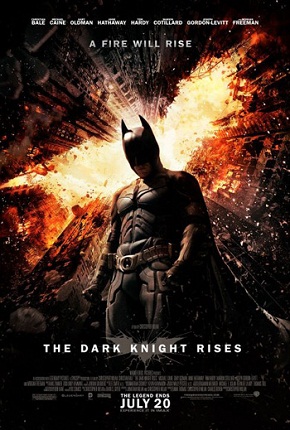
I’ve caught The Dark Knight Rises twice now and both times I enjoyed the hell out of the film. It’s unique in that– as near as I can recall– it’s the first time a comic book movie franchise didn’t fumble the ball with their third outing. Spider-Man? Marred by “wait, Uncle Ben was really killed by Sandman! Plus we have three villains! And will rush them all! And, oh yeah, that dance number!” X-Men? Didn’t live up to the first two. First round of Batman films? I submit to you “Bat-nipples” and raise you Jim Carrey. So, purely on the basis of “not sucking the third time out,” the Dark Knight Trilogy more or less stands alone. Personally, I think Christopher Nolan hit this out of the park. Spoilers below the fold.
One thing this movie unapologetically was was an ending to the Bat mythos. I think that was the level it most affected me on. I’ve been reading Batman comic books for decades, my collection of Bat-issues alone number in the thousands (I really need to catalogue them all), and I’ve read most of the significant arcs for the character. The Dark Knight Rises was immediately recognizable as a mash-up of The Dark Knight Returns, Knightfall, and No Man’s Land. Put all three stories in a blender and you wind up with something that pays homage but is an entirely new story.
Over the years I’ve seen Batman die, forced to retire, train a new successor, come out of retirement, the whole gamut. But what I’ve seldom seen (so seldom I can’t come up with a story off the top of my head) is a happy ending. Part of that is the corporate nature of the character– Batman is part of a stable of characters that have been successfully divorced from their creator and/or their creator’s vision and part of the necessary conceit of that is that the adventure– the mission– is never-ending. That real world element has been hardwired into Batman over the past forty years or so as a key characteristic of the character. This led to stories like Miller’s Dark Knight Returns, where Batman (despite retiring) must come back because the mission isn’t over (and ends on what I always found a downer note of Batman living in a cave with kids… we’ll just ignore Dark Knight Strikes Again). It’s resulted in a Bruce Wayne, old and cane-ridden, who has alienated himself from his friends and former partners (Batman Beyond). Or a Batman who makes the ultimate sacrifice and dies killing a god (Darkseid in Final Crisis).
What you don’t see is a Batman that is allowed to move on, to start his own life. I always go back to that scene from Mask of the Phantasm, where Bruce is in the rain kneeling at his parents graves– Kevin Conroy’s performance just phenomenal– pleading to them that he wants a life, he wants to get married, he needs things to be different now. True to form, he doesn’t get it in MotP. But I always wish he had.
In The Dark Knight Rises, he does. There is a happy ending. And while it might fly in the face of established Batman stories, I think it works for two reasons. First, Nolan’s Bat-films never fully embraced Batman’s “holy mission” aspect of the character. He was always geared towards a Gotham that would not need him, especially in the second film when he saw Harvey Dent as his successor and way out. Bruce only returned to Gotham in the first film after learning its corruption had made it a target of the League of Shadows. Like the detective aspect of the character, the holy mission element just never made it into the Nolan canon that strongly. Secondly, these three movies are Christopher Nolan’s take on the character. It has a beginning, a middle, and an end, and– unlike the comics– is still tied to a creator’s vision. Batman films live on, but not in this universe, not these interpretations. Nolan doesn’t have to worry about leaving the blocks in place for the next guy, this is the end of the Batman.
In terms of execution, I was very pleased. Batman flies the nuclear bomb out to sea, thereby saving his city from destruction. The public is aware of this– and finally of the lie he willingly shouldered to protect the image of Harvey Dent– and realized the true measure of this hero. In that final act of self-sacrifice, Batman finally achieved what Ra’s Al Ghul predicted in the first film: he became a legend. A symbol that will inspire future generations.
We got closure with Jim Gordon finding out Batman was Bruce Wayne. We had the next generation taking up the mantle in the form of John “Robin” Blake, ensuring that the city will not lack for a hero in a time of need. We had Lucius Fox have just the barest of hints that he might still be out there.
But, most importantly, we had Alfred. Michael Caine’s performance was incredibly emotional and his weeping apology to Thomas and Martha’s tombstones that he’d failed them was heartbreaking. Yet, just when he got to his lowest point– Bruce appeared to let him know that he’d forgiven him, he’d survived, and he’d moved on to start a new life, just as Alfred had always hoped for.
Bruce Wayne accepting that he deserves a life is something unlikely to happen in the comic books. He’s just not wired that way. But Christopher Nolan’s Bruce Wayne can and, in the end, he does. This turns Batman from an enduring corporate figure into a character with a clear arc. Whereas one’s arc can never definitively end, this one can.
Did I have quibbles? Absolutely. Batman immediately retiring after the events of The Dark Knight still bother me. I think it should have been massaged to have been some time in the intervening 8 years rather than ALL 8 years. But that’s a minor quibble that is easily overlooked.
In the end, The Dark Knight Rises was an exciting movie that finally gave the Dark Knight what he deserved: a happy ending.
And naturally it was with Catwoman.